
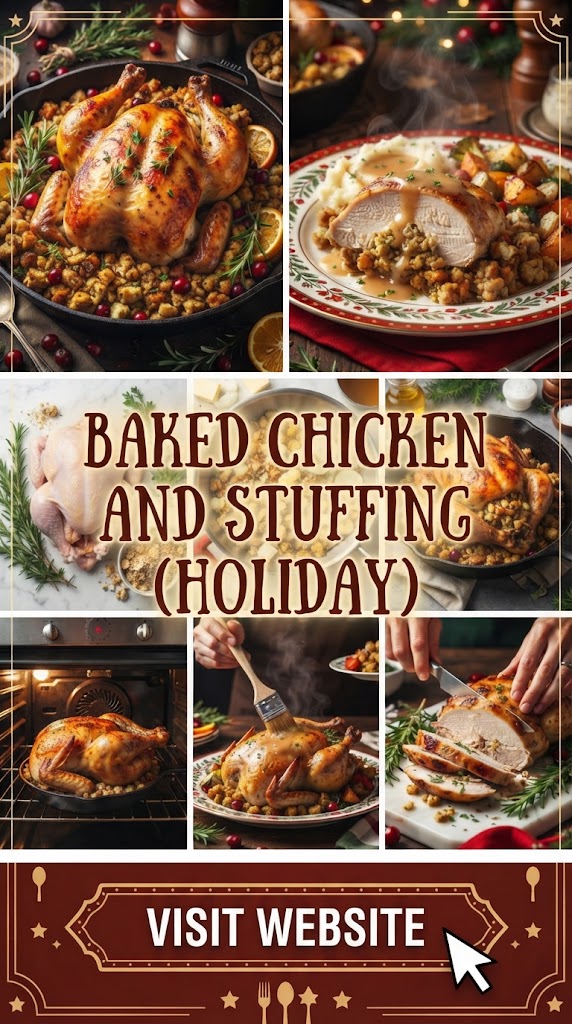
Baked Chicken and Stuffing (Holiday)
Baked Chicken and Stuffing (Holiday)
Baked Chicken and Stuffing is the kind of comforting holiday dinner that brings together everything people love about a traditional feast: juicy, tender chicken, savory herb-seasoned stuffing, buttery vegetables, and a golden, crisp top. It is hearty enough for Thanksgiving, Christmas, Sunday dinner, or any cold-weather family gathering, yet simple enough to prepare without spending the entire day in the kitchen.
This recipe combines chicken and stuffing in one baking dish, allowing the flavors to mingle as everything cooks. The chicken stays moist and flavorful while the stuffing absorbs delicious juices from the meat, creating a wonderfully savory side dish right alongside the main course.
The recipe below includes a complete ingredient list, detailed cooking instructions, preparation tips, variations, serving suggestions, storage information, reheating instructions, and answers to common questions.
Why You’ll Love This Holiday Chicken and Stuffing
There are plenty of reasons this recipe deserves a place on your holiday table.
Comforting and satisfying: Chicken and stuffing are a classic combination that feels like a complete comfort-food meal.
Easy preparation: Instead of preparing several complicated dishes separately, you can bake the chicken and stuffing together in one casserole dish.
Family-friendly: The mild savory flavors appeal to both adults and children.
Perfect for holidays: The herbs, butter, onions, celery, and golden stuffing create a festive flavor profile without requiring complicated ingredients.
Great for leftovers: Leftover chicken and stuffing can easily become another meal the next day.
Flexible: You can use chicken breasts, boneless thighs, or a combination depending on your preference.
Complete Baked Chicken and Stuffing Recipe
Recipe Overview
Recipe Name: Baked Chicken and Stuffing
Cuisine: American
Category: Dinner / Holiday
Preparation Time: 20 minutes
Cooking Time: 45–60 minutes
Total Time: About 1 hour 20 minutes
Servings: 6
Difficulty: Easy to Moderate
Ingredients
For the Chicken
- 6 boneless, skinless chicken breasts, approximately 6 ounces each
- 2 tablespoons olive oil
- 1 teaspoon kosher salt
- 1 teaspoon garlic powder
- 1 teaspoon paprika
- ½ teaspoon black pepper
- ½ teaspoon dried thyme
- ½ teaspoon dried sage
- ¼ teaspoon onion powder
For the Stuffing
- 1 package, about 6 ounces, seasoned stuffing mix
- 2 tablespoons butter
- 1 medium yellow onion, finely diced
- 2 celery stalks, finely diced
- 2 cloves garlic, minced
- 2 cups chicken broth
- ½ teaspoon dried sage
- ½ teaspoon dried thyme
- ¼ teaspoon black pepper
- ¼ teaspoon salt, or to taste
- 2 tablespoons chopped fresh parsley
Optional Ingredients
For additional holiday flavor, you can also add:
- ½ cup dried cranberries
- ½ cup chopped pecans
- ½ cup diced mushrooms
- ½ cup shredded Parmesan cheese
- ½ cup diced cooked sausage
- 1 tablespoon fresh rosemary
- 1 tablespoon fresh sage
- 2 tablespoons melted butter for the stuffing topping
How to Choose the Chicken
Chicken breasts are especially convenient for this recipe because they cook relatively quickly and provide a lean source of protein.
However, chicken thighs are another excellent option. Boneless, skinless thighs tend to remain especially juicy during baking because they contain more fat.
If using chicken breasts, try to choose pieces of similar thickness. Very thick chicken breasts can take longer to cook than thin pieces, which can make it difficult to time the chicken and stuffing perfectly.
For very thick breasts, gently pound them to an even thickness before seasoning.
How to Prepare the Stuffing
The stuffing is one of the most important parts of this dish. You want it moist and flavorful inside while allowing the top to become lightly golden.
Begin by preheating your oven to 375°F (190°C).
Lightly grease a 9-by-13-inch baking dish with butter or cooking spray.
Place a large skillet over medium heat.
Add the butter.
Once melted, add the diced onion and celery.
Cook for approximately 4–5 minutes, stirring occasionally, until the vegetables begin to soften.
Add the minced garlic and cook for another 30–60 seconds.
Be careful not to burn the garlic.
Pour in the chicken broth and add the sage, thyme, black pepper, and salt.
Bring the mixture just to a gentle simmer.
Remove the skillet from the heat.
Add the seasoned stuffing mix.
Stir gently until the bread pieces absorb the broth.
Add fresh parsley.
Allow the stuffing mixture to sit for about 3–5 minutes.
The stuffing should be moist but not completely soggy.
If it looks excessively dry, add a small amount of additional chicken broth.
If it looks too wet, allow it to stand for several minutes before placing it into the baking dish.
How to Season the Chicken
While the stuffing rests, prepare the chicken.
Pat each chicken breast dry with paper towels.
This small step is important because removing excess moisture helps the seasoning adhere better and encourages better browning.
Place the chicken breasts on a clean plate or cutting board.
Drizzle the chicken with olive oil.
Combine the salt, garlic powder, paprika, black pepper, thyme, sage, and onion powder in a small bowl.
Sprinkle the seasoning mixture evenly over both sides of the chicken.
Gently rub the seasoning into the meat.
Make sure the chicken is evenly coated.
How to Assemble Baked Chicken and Stuffing
Spread the prepared stuffing evenly across the bottom of the greased baking dish.
Use the back of a spoon to create an even layer.
Arrange the seasoned chicken breasts over the stuffing.
Try not to overlap the chicken pieces.
If the chicken breasts are very large, leave a little space between them so heat can circulate.
For an extra-rich holiday flavor, drizzle a small amount of melted butter over the chicken and stuffing.
Cover the baking dish tightly with aluminum foil.
The foil helps trap moisture during the first portion of baking.
How to Cook Baked Chicken and Stuffing
Place the covered baking dish into the preheated 375°F (190°C) oven.
Bake for approximately 25–30 minutes.
Remove the foil.
Continue baking for another 15–25 minutes, depending on the thickness of the chicken.
The chicken should reach an internal temperature of 165°F (74°C) at the thickest part.
Use an instant-read thermometer to check the temperature.
Insert the thermometer into the thickest portion of the chicken without touching the bottom of the baking dish.
The stuffing should be hot throughout, moist in the center, and lightly golden on top.
If you want a more deeply browned stuffing surface, you can place the dish under the broiler for 1–2 minutes at the end.
Watch it carefully because stuffing can brown quickly under the broiler.
Step-by-Step Cooking Instructions
Step 1: Preheat the Oven
Preheat your oven to 375°F (190°C).
Grease a 9-by-13-inch baking dish.
Step 2: Prepare the Vegetables
Melt butter in a skillet.
Add diced onion and celery.
Cook until softened.
Add garlic and cook briefly.
Step 3: Add the Broth
Pour chicken broth into the skillet.
Add sage, thyme, pepper, and salt.
Bring the mixture to a gentle simmer.
Step 4: Add the Stuffing Mix
Remove the skillet from the heat.
Stir in the stuffing mix.
Add parsley.
Let the mixture absorb the broth for several minutes.
Step 5: Season the Chicken
Pat chicken breasts dry.
Rub them with olive oil.
Season both sides thoroughly.
Step 6: Assemble
Spread stuffing into the prepared baking dish.
Place seasoned chicken over the stuffing.
Step 7: Cover
Cover the baking dish tightly with aluminum foil.
Step 8: Bake
Bake at 375°F for approximately 25–30 minutes covered.
Step 9: Finish Baking
Remove the foil.
Continue baking for approximately 15–25 minutes.
Step 10: Check Temperature
Check the thickest chicken breast with an instant-read thermometer.
Chicken should reach 165°F (74°C).
Step 11: Brown the Top
If desired, broil briefly to give the stuffing a beautiful golden crust.
Step 12: Rest
Remove the dish from the oven.
Let it rest for approximately 5–10 minutes before serving.
The Secret to Moist Chicken
The biggest challenge with baked chicken breasts is preventing them from becoming dry.
There are several simple ways to help.
Don’t Overcook the Chicken
The most important rule is to use a thermometer.
Chicken breast becomes increasingly dry as it cooks beyond the temperature needed for safety.
Checking the internal temperature is much more reliable than judging doneness by cooking time alone.
Use Similar-Sized Chicken Pieces
If one chicken breast is much larger than another, they will not finish at the same time.
Choose similarly sized pieces whenever possible.
Cover During the First Stage
The foil traps steam and helps prevent excessive moisture loss.
Removing the foil toward the end allows the stuffing to brown while the chicken finishes cooking.
Let the Chicken Rest
Allowing the chicken to rest for 5–10 minutes after baking gives the juices time to redistribute.
How to Make the Stuffing Extra Flavorful
Stuffing can be customized in many ways.
For a richer holiday version, sauté the vegetables in butter instead of oil.
Fresh herbs also make a major difference.
Fresh sage, thyme, parsley, and rosemary can add a bright, aromatic flavor.
You can also add diced mushrooms for an earthy taste.
For sweetness, dried cranberries work beautifully.
For crunch, chopped pecans or walnuts are excellent.
If your family enjoys sausage stuffing, add cooked crumbled sausage to the stuffing mixture before assembling the casserole.
Holiday Stuffing Variations
Cranberry and Pecan Stuffing
Add ½ cup dried cranberries and ½ cup chopped pecans.
The cranberries provide sweetness while the pecans add crunch.
This variation works particularly well for Thanksgiving and Christmas.
Sausage Stuffing
Cook approximately ½ pound of mild Italian sausage or breakfast sausage.
Drain excess grease.
Stir the cooked sausage into the stuffing mixture.
The result is richer and heartier.
Mushroom Stuffing
Sauté ½ cup to 1 cup sliced mushrooms with the onion and celery.
Cook until the mushrooms release their moisture and begin to brown.
Then continue with the recipe.
Cheesy Chicken and Stuffing
Sprinkle approximately ½ cup shredded mozzarella, cheddar, or Parmesan over the stuffing before adding the chicken.
You can also add a small amount of cheese during the final 10 minutes of baking.
Creamy Chicken and Stuffing
For an especially creamy casserole, mix a can of condensed cream of chicken soup with approximately ½ cup chicken broth.
Spread the mixture beneath or through the stuffing before adding the chicken.
This produces a richer, creamier holiday casserole.
Fresh Herbs vs. Dried Herbs
Both fresh and dried herbs work well.
Dried sage and thyme are convenient and provide concentrated flavor.
Fresh herbs create a brighter aroma.
As a general rule, when substituting fresh herbs for dried herbs, you will usually need more fresh herbs because dried herbs are more concentrated.
For this recipe, fresh parsley is especially useful because it adds freshness to the rich stuffing.
What to Serve With Chicken and Stuffing
Because chicken and stuffing already make a substantial meal, simple vegetable sides work especially well.
Green Beans
Steamed or roasted green beans provide color and freshness.
Roasted Carrots
Roasted carrots add natural sweetness that balances the savory chicken.
Cranberry Sauce
A spoonful of cranberry sauce adds a sweet-tart contrast.
Mashed Potatoes
For a traditional holiday feast, creamy mashed potatoes are an excellent choice.
Gravy
A light chicken gravy poured over the chicken and stuffing makes the dish even more comforting.
Dinner Rolls
Warm dinner rolls are perfect for soaking up flavorful juices and gravy.
Simple Green Salad
A crisp salad can provide a refreshing contrast to the rich casserole.
How to Make Homemade Gravy
If you want to serve gravy with this meal, you can make a simple version using chicken broth.
Melt 2 tablespoons butter in a saucepan.
Whisk in 2 tablespoons all-purpose flour.
Cook for approximately 1–2 minutes.
Gradually whisk in 1½ cups chicken broth.
Continue whisking until smooth.
Simmer until thickened.
Season with salt, pepper, and a small amount of thyme or sage.
Serve warm over the chicken and stuffing.
Tips for the Best Baked Chicken and Stuffing
Use Good-Quality Chicken
Fresh chicken breasts or thighs will produce the best texture.
Don’t Make the Stuffing Too Wet
The chicken will release additional juices during baking.
Overly wet stuffing can become mushy.
Season Every Layer
Season the chicken and stuffing separately so the entire dish has balanced flavor.
Don’t Skip the Resting Period
Allowing the casserole to rest for several minutes makes serving easier and allows the chicken juices to settle.
Use a Thermometer
Cooking time can vary depending on the size and thickness of the chicken.
Temperature is the best indicator of doneness.
Add Fresh Herbs at the End
Fresh parsley sprinkled over the finished dish gives it a beautiful holiday appearance.
Brown the Stuffing
Removing the foil near the end allows the top to develop a delicious golden crust.
Can You Use Chicken Thighs?
Absolutely.
Boneless, skinless chicken thighs are excellent for this recipe.
They are naturally more forgiving than chicken breasts because their higher fat content helps them remain juicy.
Use approximately 6 boneless thighs.
Season them exactly as you would the chicken breasts.
Cooking time may vary depending on the size of the thighs, so use an instant-read thermometer.
Can You Use Bone-In Chicken?
Yes.
Bone-in chicken can provide additional flavor, but it generally requires more cooking time.
Bone-in chicken breasts or thighs should be arranged over the stuffing without overlapping.
Check the thickest portion with a thermometer and continue baking until the chicken reaches a safe internal temperature.
Because bone-in chicken takes longer, the stuffing may brown before the chicken finishes.
If that happens, loosely cover the dish with foil again.
Can You Make This Recipe Ahead of Time?
Yes.
This is one reason Baked Chicken and Stuffing is so useful for holiday meals.
You can prepare the stuffing mixture several hours in advance and refrigerate it.
When you’re ready to cook, season the chicken and assemble the casserole.
If the ingredients are cold from the refrigerator, the casserole may require additional baking time.
Do not rely solely on the recipe’s estimated cooking time. Check the chicken temperature.
For best results, avoid leaving raw chicken at room temperature for extended periods.
How to Store Leftovers
Allow leftovers to cool appropriately, then place them in airtight containers.
Store refrigerated leftovers for up to 3–4 days.
Keep the chicken and stuffing refrigerated promptly rather than leaving the casserole at room temperature for long periods.
For easier reheating, divide leftovers into individual portions.
How to Reheat Baked Chicken and Stuffing
The oven is one of the best ways to reheat leftovers.
Place chicken and stuffing in an oven-safe dish.
Add a small splash of chicken broth to the stuffing.
Cover loosely with foil.
Reheat at approximately 325°F (165°C) until heated through.
You can remove the foil during the final few minutes if you want the stuffing top to crisp again.
Individual portions can also be reheated in a microwave.
Cover the portion loosely and heat in short intervals, stirring or rotating where appropriate.
Make sure the food is heated thoroughly before serving.
Can You Freeze Chicken and Stuffing?
Yes, although the texture of the stuffing may change slightly after freezing and thawing.
For best results, divide the leftovers into airtight freezer-safe containers.
Freeze for approximately 2–3 months for best quality.
Thaw in the refrigerator before reheating.
Reheat thoroughly in the oven.
Adding a small amount of chicken broth before reheating can help restore moisture to the stuffing.
Common Mistakes to Avoid
Mistake 1: Overcooking the Chicken
This is the most common problem.
Always check the internal temperature.
Mistake 2: Too Much Liquid
Stuffing needs moisture, but excessive broth can make it mushy.
Add broth gradually.
Mistake 3: Not Covering the Casserole
Starting the bake covered helps retain moisture.
Mistake 4: Cutting the Chicken Immediately
Allow the chicken to rest before slicing.
Mistake 5: Uneven Chicken Pieces
Very thick breasts can take much longer to cook.
Pound them gently to create a more even thickness.
Mistake 6: Forgetting Seasoning
Stuffing and chicken both need adequate seasoning.
Taste the stuffing mixture before adding the raw chicken, adjusting seasoning as needed.
How to Make This Recipe More Festive
For a holiday presentation, garnish the finished casserole with chopped fresh parsley.
You can also scatter a few fresh rosemary sprigs around the serving platter.
Serve with cranberry sauce, gravy, roasted vegetables, and warm dinner rolls.
A few dried cranberries mixed into the stuffing provide attractive color and a pleasant sweet-tart flavor.
For a more luxurious dish, add sautéed mushrooms, sausage, or toasted pecans.
Nutritional Considerations
The nutritional value of this dish depends on the exact ingredients and portion sizes.
Chicken provides protein, while the stuffing contributes carbohydrates.
Butter and oil add fat and richness.
Using reduced-sodium chicken broth and stuffing mix can help reduce overall sodium.
For a lighter version, use less butter and choose skinless chicken breasts.
Adding vegetables such as celery, onion, mushrooms, and carrots can increase the vegetable content of the meal.
Frequently Asked Questions
Can I use boxed stuffing mix?
Yes. Boxed seasoned stuffing mix is convenient and works very well in this recipe.
Can I use homemade stuffing?
Absolutely. Homemade stuffing can be substituted for packaged stuffing.
Just make sure it has enough moisture to remain tender during baking without becoming overly wet.
Should the stuffing go under or around the chicken?
Either approach works, but spreading it beneath the chicken allows it to absorb flavorful juices as the chicken cooks.
Can I use chicken thighs instead of breasts?
Yes. Boneless, skinless chicken thighs are an excellent substitute.
Why is my stuffing soggy?
Too much liquid is usually the cause. Add broth gradually and remember that the chicken will also release moisture during baking.
Why is my chicken dry?
It was probably cooked too long. Chicken breasts are particularly susceptible to drying out, so use a thermometer rather than relying only on cooking time.
Can I add cheese?
Yes. Cheddar, mozzarella, Parmesan, or Gruyère can all work depending on the flavor profile you want.
Can I add vegetables?
Definitely. Mushrooms, carrots, peas, spinach, and additional celery are good options.
Can I prepare this for Thanksgiving?
Yes. It makes an excellent alternative to a whole turkey when you want a smaller, simpler holiday meal.
Can I double the recipe?
Yes, but use a larger baking dish and make sure the chicken pieces are arranged in a single layer. Cooking time may increase.
Easy Holiday Dinner Timeline
If you’re preparing this dish as part of a larger holiday meal, organization makes everything easier.
Earlier in the Day
Chop the onion and celery.
Measure the herbs and seasonings.
Prepare the stuffing vegetables.
Prepare any additional vegetables you plan to serve.
About 1½ Hours Before Dinner
Preheat the oven.
Prepare the stuffing.
Season the chicken.
Assemble the casserole.
About 1 Hour Before Dinner
Place the covered casserole into the oven.
About 30 Minutes Before Dinner
Remove the foil.
Continue baking until the chicken reaches 165°F.
Before Serving
Allow the casserole to rest for 5–10 minutes.
Prepare gravy.
Warm dinner rolls.
Garnish the chicken and stuffing with fresh parsley.
The Best Way to Serve It
For a family-style presentation, place the baking dish directly on a heat-safe serving surface.
Spoon stuffing onto each plate first.
Place a chicken breast or thigh on top.
Drizzle with warm gravy.
Add cranberry sauce on the side.
Finish with fresh parsley.
The combination of savory stuffing, juicy chicken, rich gravy, and sweet-tart cranberry sauce creates a classic holiday plate.
Final Recipe Card
Baked Chicken and Stuffing
Servings: 6
Prep Time: 20 minutes
Cook Time: 45–60 minutes
Oven Temperature: 375°F (190°C)
Ingredients
- 6 boneless, skinless chicken breasts
- 2 tablespoons olive oil
- 1 teaspoon kosher salt
- 1 teaspoon garlic powder
- 1 teaspoon paprika
- ½ teaspoon black pepper
- ½ teaspoon dried thyme
- ½ teaspoon dried sage
- ¼ teaspoon onion powder
- 1 package seasoned stuffing mix
- 2 tablespoons butter
- 1 medium onion, diced
- 2 celery stalks, diced
- 2 garlic cloves, minced
- 2 cups chicken broth
- ½ teaspoon dried sage
- ½ teaspoon dried thyme
- ¼ teaspoon black pepper
- ¼ teaspoon salt
- 2 tablespoons fresh parsley
Directions
- Preheat oven to 375°F (190°C).
- Grease a 9-by-13-inch baking dish.
- Melt butter in a skillet.
- Sauté onion and celery until softened.
- Add garlic and cook briefly.
- Add chicken broth, sage, thyme, pepper, and salt.
- Remove from heat and stir in stuffing mix and parsley.
- Let stuffing absorb the broth for 3–5 minutes.
- Pat chicken dry.
- Rub chicken with olive oil.
- Season both sides with the spice mixture.
- Spread stuffing evenly in the baking dish.
- Arrange chicken over the stuffing.
- Cover tightly with foil.
- Bake for 25–30 minutes.
- Remove foil.
- Continue baking for 15–25 minutes.
- Check the chicken with an instant-read thermometer.
- Chicken should reach 165°F (74°C).
- Rest for 5–10 minutes before serving.
- Garnish with fresh parsley and serve with gravy or cranberry sauce.
Conclusion
Baked Chicken and Stuffing is a simple, comforting holiday meal that delivers the flavors of a traditional celebration without requiring an entire turkey or complicated preparation. Tender seasoned chicken rests on a bed of buttery, herb-filled stuffing, creating a complete meal in one convenient baking dish.
The recipe is flexible enough for Thanksgiving, Christmas, Sunday dinner, or an ordinary weeknight when you want something warm and satisfying. You can customize it with sausage, mushrooms, cranberries, pecans, fresh herbs, or cheese to create your own family version.
The most important things to remember are to avoid overcooking the chicken, keep the stuffing moist but not soggy, and use a thermometer to verify that the chicken reaches 165°F (74°C).
Serve it with mashed potatoes, green beans, cranberry sauce, gravy, and warm rolls for a classic holiday feast—or enjoy it by itself for an easy and satisfying family dinner.